Order of Skin Care Routine: Avoid These Common Mistakes!
Standing in front of your bathroom mirror with a counter full of products can feel overwhelming. Should the serum come before moisturizer? Where does sunscreen fit in? If you’ve ever wondered about the correct Order of Skin Care Routine, you’re not alone.
The sequence in which you apply your products significantly impacts their effectiveness. Using products in the wrong order might prevent active ingredients from penetrating properly or could reduce their benefits entirely. Let’s demystify the proper skincare routine steps and create a foolproof system for both morning and evening care.
Table of Contents
The Science Behind Proper Skincare Product Layering
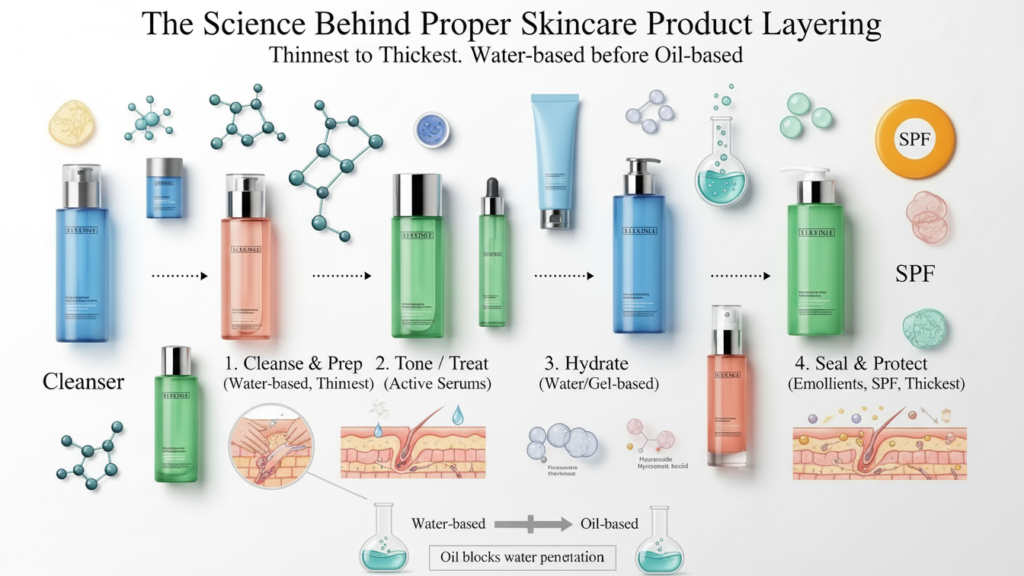
There’s actual science backing the importance of product order. The general rule follows a simple principle: apply products from thinnest to thickest consistency. This allows lighter formulations with active ingredients to penetrate deeply before sealed in by heavier products.
Additionally, water-based products should precede oil-based ones, as oil can create a barrier that water-based formulas cannot penetrate. Understanding these fundamentals helps maximize the benefits of every product in your regimen.
Morning Skincare Routine Order
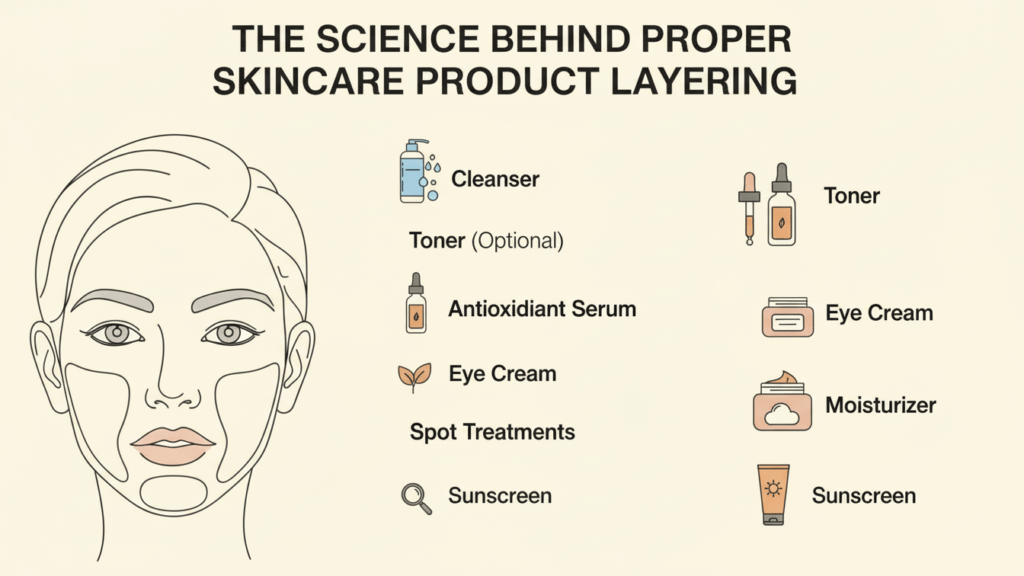
Your AM Order of Skin Care Routine focuses primarily on protection against environmental aggressors like pollution, UV rays, and oxidative stress. Here’s the ideal sequence:
Step 1: Cleanser
Begin with a gentle cleanser to remove any residue from overnight products and natural oils that accumulated while sleeping. Morning cleansers should be mild to avoid stripping natural oils.
- For oily skin: Gel or foaming cleanser
- For dry skin: Cream or lotion cleanser
- For sensitive skin: Micellar water or sulfate-free formula
If your skin feels clean upon waking, you might even skip this step and simply rinse with lukewarm water.
Step 2: Toner (Optional)
Modern toners balance the skin’s pH and provide a first layer of hydration rather than strip the skin like old-school astringents.
Apply by patting gently with hands or a cotton pad. Look for hydrating ingredients like glycerin, hyaluronic acid, and antioxidants rather than alcohol-heavy formulations.
Step 3: Antioxidant Serum
Serums deliver concentrated active ingredients with smaller molecular weights designed to penetrate deeply. For mornings, vitamin C serums are particularly beneficial as they:
- Neutralize free radicals from UV and pollution exposure
- Brighten skin tone
- Boost sunscreen’s protective capabilities
- Promote collagen production
Apply 3-5 drops and gently press into the skin, allowing 60 seconds for absorption before proceeding.
Step 4: Eye Cream
The delicate eye area benefits from targeted treatment. Apply eye cream using your ring finger (which naturally applies the least pressure) and tap gently around the orbital bone.
Morning eye creams often contain caffeine to reduce puffiness, peptides for fine lines, or vitamin C for brightening dark circles.
Step 5: Spot Treatments
If you’re addressing specific concerns like acne spots or hyperpigmentation, apply targeted treatments now. However, certain ingredients (like benzoyl peroxide) may be better suited for evening routines as they can increase sun sensitivity.
Step 6: Moisturizer
Even oily skin needs hydration. Choose a formula appropriate for your skin type:
- Oily skin: Oil-free, gel-based moisturizers
- Combination skin: Lightweight lotions
- Dry skin: Richer creams with ceramides and fatty acids
Allow your moisturizer to fully absorb for about a minute before the final essential step.
Step 7: Sunscreen
This is non-negotiable, regardless of weather or season. Apply at least SPF 30 (preferably SPF 50) as your final skincare step before makeup.
Use approximately a nickel-sized amount for the face and remember to extend protection to your neck and the backs of your hands. The American Academy of Dermatology recommends reapplying every two hours when outdoors.
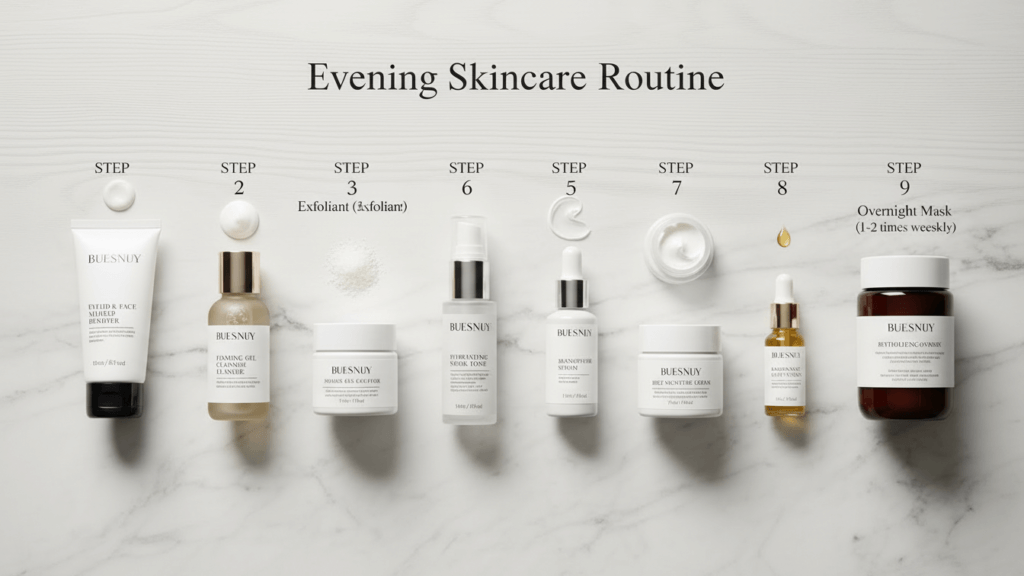
Evening Skincare Routine Order
Your PM Order of Skin Care Routine focuses on repair and regeneration while you sleep. This is when you can introduce more intensive treatments and ingredients.
Step 1: Makeup Remover
If wearing makeup or sunscreen (which you should be!), start with a dedicated makeup remover:
- Cleansing balms and oils excel at dissolving stubborn makeup and sunscreen
- Micellar water works well for lighter coverage
Step 2: Cleanser
Follow with a proper facial cleanser to remove any remaining impurities. This “double cleansing” ensures your skin is thoroughly clean before applying active ingredients.
Evening cleansers can be slightly more robust than morning formulations since they need to remove a day’s worth of buildup.
Step 3: Exfoliant (2-3 times weekly)
Exfoliation removes dead skin cells to improve product penetration and cellular turnover. Choose either:
- Chemical exfoliants: AHAs (glycolic, lactic acid) for surface exfoliation and brightening, or BHAs (salicylic acid) for deeper pore-clearing benefits
- Physical exfoliants: Gentle scrubs or cleansing devices
Start with twice-weekly application, then adjust based on your skin’s response. Over-exfoliation can damage your skin barrier, so more isn’t always better.
Step 4: Toner
Evening toners can include more active ingredients like AHAs/BHAs (if you’re not using a separate exfoliant) or ingredients like niacinamide for barrier support.
Step 5: Treatments and Serums: The Heart of Proper Skincare Routine Steps
Nighttime is ideal for your most potent active ingredients. Apply treatments in order of thinnest to thickest consistency:
- Prescription treatments: Medications like tretinoin or azelaic acid should be applied to clean, dry skin
- Serums: Target specific concerns with ingredients like:
- Retinoids for anti-aging, texture, and acne
- Peptides for firming and collagen production
- Niacinamide for pore refinement and barrier support
- Hyaluronic acid for deep hydration
Wait approximately 1-2 minutes between different active ingredients to minimize potential irritation and allow proper absorption.
Step 6: Eye Cream
Evening eye creams often contain richer ingredients like retinol (in formulations specifically designed for the delicate eye area), peptides, or growth factors to address fine lines and texture overnight.
Step 7: Moisturizer
Evening moisturizers are typically richer than daytime formulas. Look for ingredients like ceramides, peptides, and fatty acids that support overnight barrier repair.
Step 8: Face Oil (Optional)
If your skin needs additional nourishment, facial oils provide a final seal to lock in all previous products. Even oily skin types can benefit from balancing oils like jojoba or squalane.
Apply 2-3 drops, warming between palms before pressing (not rubbing) onto skin.
Step 9: Overnight Mask (1-2 times weekly)
As an occasional treatment, sleeping masks provide intensive benefits while you rest. These range from deeply hydrating formulas to those targeting specific concerns like brightening or firming.
Special Considerations for Product Combinations
Not all skincare ingredients play well together. Understanding which combinations to avoid prevents irritation and maximizes efficacy:
Potentially Conflicting Combinations
- Retinoids + AHAs/BHAs: Can cause excessive irritation; use on alternate nights or with sufficient time between applications
- Vitamin C + AHAs/BHAs: May cause irritation and reduce vitamin C stability; best used at different times of day
- Retinoids + Benzoyl Peroxide: Can deactivate each other; space applications or use on alternate days
When introducing multiple active ingredients, research supports a gradual approach to minimize irritation and allow your skin to adapt.
Adjusting Your Routine for Skin Type and Concerns
While the basic sequence remains consistent, specific skin concerns require thoughtful modifications:
For Acne-Prone Skin
- Incorporate BHA (salicylic acid) to clear pores
- Consider non-comedogenic formulations for all products
- Include ingredients like niacinamide to regulate sebum production
- Use lightweight, hydrating layers rather than heavy occlusive products
For Hyperpigmentation
- Focus on brightening ingredients like vitamin C, alpha arbutin, and tranexamic acid
- Prioritize consistent sunscreen use to prevent darkening of spots
- Consider AHAs to accelerate cell turnover
For Aging Concerns
- Emphasize retinoids in your evening routine
- Include peptides and growth factors for collagen support
- Ensure adequate hydration with multiple lightweight layers
- Never skip sunscreen, the most effective anti-aging product
Listen to your skin’s feedback and adjust accordingly. Skin cycling – alternating active ingredients on different days – can be beneficial for those with sensitive skin who still want to incorporate multiple actives.
Final Thoughts on Skincare Layering
The proper order of your skincare routine enhances the effectiveness of every product you apply. While following these guidelines provides a solid framework, remember that consistency matters more than complexity.
It’s better to maintain a simple, consistent routine than to perform an elaborate 12-step process sporadically. Pay attention to how your skin responds and adjust accordingly – skincare should be personalized to your unique needs.
Most importantly, give products sufficient time to show results. While some ingredients (like hyaluronic acid) provide immediate benefits, others (like retinoids) require weeks or months of consistent use to demonstrate their full potential.
By understanding the science behind proper product layering and following a logical application sequence, you’ll maximize the effectiveness of every product in your skincare arsenal and be well on your way to achieving your skin goals.