Gentle Skincare for Sensitive Skin: Safe & Effective Picks
Have you ever tried a new face cream only to wake up with redness, itching, or breakouts? If your skin seems to protest against nearly every product you try, you’re not alone. Sensitive skin affects millions of people, making the quest for effective hypoallergenic skincare products feel like searching for a needle in a haystack.
But here’s the good news: with the right knowledge and products, you can build a skincare routine that nurtures rather than irritates your delicate skin barrier. Let’s dive into everything you need to know about caring for sensitive skin, including how to select gentle Skincare for sensitive skin naturally.
Table of Contents
Understanding Sensitive Skin: More Than Just a Label
Sensitive skin isn’t a clinical diagnosis but rather a term describing skin that reacts more strongly than usual to environmental factors, products, or ingredients. Your skin might be considered sensitive if you frequently experience:
– Redness or flushing
– Burning or stinging sensations
– Itching or discomfort
– Dryness or flakiness
– Bumps, rashes, or breakouts after using products
Dr. Whitney Bowe, a board-certified dermatologist, explains that sensitive skin often stems from a compromised skin barrier—the outermost protective layer that keeps irritants out and moisture in.
Common Triggers for Sensitive Skin Reactions
Before diving into product recommendations, let’s identify what might be causing your skin to react:
Ingredient Irritants
Some common skincare ingredients are notorious for triggering reactions in sensitive skin:
– Fragrances (artificial and natural)
– Alcohol (especially denatured alcohol)
– Sulfates (like sodium lauryl sulfate)
– Chemical sunscreen filters (oxybenzone, avobenzone)
– Essential oils (despite being natural)
– Preservatives (parabens, formaldehyde-releasers)
Environmental Factors
Your skin’s sensitivity can fluctuate based on:
– Weather changes (especially cold, dry conditions)
– Pollution exposure
– Sun damage
– Indoor heating or air conditioning
– Hard water
Hypoallergenic Skincare: What It Actually Means
The term “hypoallergenic” appears on countless product labels, but what does it really mean? Contrary to popular belief, there’s no regulated definition or testing requirement for this claim.
Typically, hypoallergenic skincare products are formulated to minimize allergic reactions by:
– Eliminating common irritants and allergens
– Using fewer ingredients overall
– Avoiding fragrances and dyes
– Undergoing some form of sensitivity testing
However, no product can guarantee zero reactions for everyone. Even products labeled “hypoallergenic” can cause issues for some people, as skin sensitivity is highly individual.
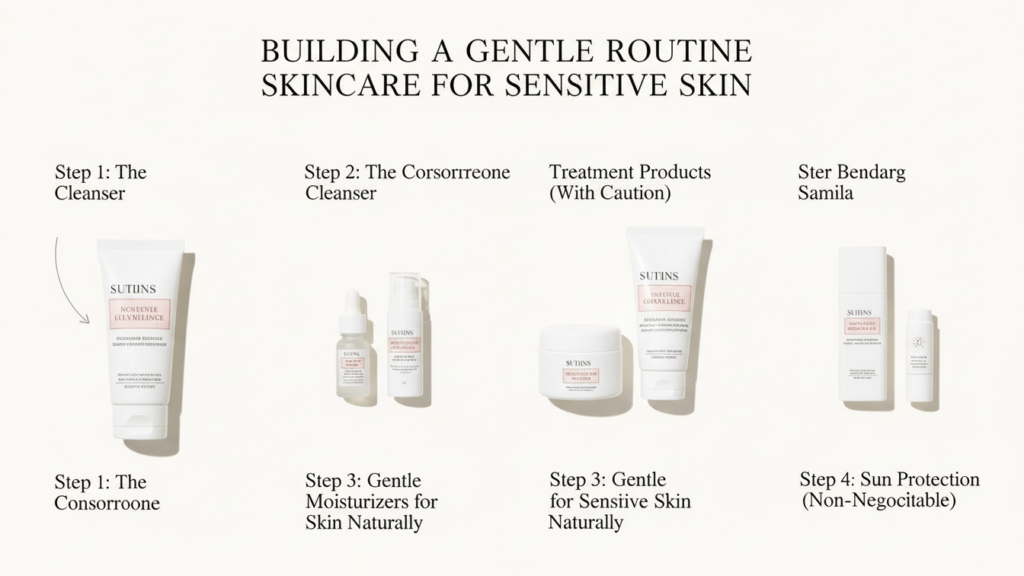
Building a Gentle Routine Skincare for Sensitive Skin
Step 1: The Cornerstone Cleanser
Your cleanser sets the foundation for your entire routine. For sensitive skin, look for:
- Cream or lotion cleansers that clean without stripping
- pH-balanced formulas (ideally 4.5-5.5)
- Fragrance-free options
- Minimal ingredient lists
Good ingredients to look for include:
– Glycerin
– Ceramides
– Allantoin
– Oat extract
Brands like Vanicream, La Roche-Posay, and Avène offer excellent gentle cleansers specifically formulated for reactive skin.
Step 2: Treatment Products (With Caution)
Active ingredients can address specific skin concerns, but approach with caution:
– Start with low concentrations (especially for ingredients like vitamin C, retinol, or acids)
– Introduce one new product at a time (waiting at least 1-2 weeks before adding another)
– Consider barrier-supporting alternatives like bakuchiol instead of retinol, or PHAs instead of stronger AHAs
Step 3: Gentle Moisturizers for Sensitive Skin Naturally
Finding Your Perfect Gentle Moisturizer
The right moisturizer can make all the difference for sensitive skin. When searching for gentle moisturizers for sensitive skin naturally, look for these characteristics:
– Minimal ingredient lists (fewer ingredients means fewer potential triggers)
– Barrier-repairing ingredients like ceramides, fatty acids, and cholesterol
– Soothing agents such as colloidal oatmeal, centella asiatica, or madecassoside
– Humectants like glycerin and hyaluronic acid to draw in moisture
– No artificial fragrances or essential oils
Some excellent moisturizer options include:
1. La Roche-Posay Toleriane Double Repair Face Moisturizer – Contains ceramides, niacinamide, and glycerin
2. Avène Tolerance Extreme Emulsion – Uses minimal ingredients with thermal spring water
3. Vanicream Moisturizing Cream – Free of dyes, fragrances, lanolin, and preservatives
4. First Aid Beauty Ultra Repair Cream – Features colloidal oatmeal, shea butter, and allantoin
For those seeking more natural options, brands like [Pai Skincare](/natural-skincare-brands) offer organic formulations specifically designed for reactive skin.
Step 4: Sun Protection (Non-Negotiable)
Sensitive skin needs sun protection more than most, but chemical sunscreens can be irritating. Instead, opt for:
– Mineral sunscreens with zinc oxide and/or titanium dioxide
– Fragrance-free formulas
– Products with additional soothing ingredients like niacinamide or centella
Specialized Treatment Ingredients for Sensitive Skin
While your routine should stay simple, certain ingredients can actively help strengthen sensitive skin:
Barrier-Repairing Champions
– Ceramides – Natural lipids that help cement skin cells together
– Niacinamide – Reduces inflammation and supports barrier function
– Panthenol (Pro-Vitamin B5) – Soothes and promotes healing
Calming Anti-Inflammatories
– Centella Asiatica (Tiger Grass/Cica) – Traditional healing herb that reduces redness
– Colloidal Oatmeal – FDA-approved skin protectant with anti-inflammatory properties
– Aloe Vera – Soothes irritation and provides light hydration
– Green Tea Extract – Powerful antioxidant with calming properties
Testing New Products Safely
For those with sensitive skin, introducing new products requires strategy:
1. Patch test first – Apply a small amount behind your ear or on your inner forearm for 24-48 hours
2. Introduce gradually – Start with every other day application
3. Simplify during reactions – If your skin flares up, return to a minimal routine of just cleanser, moisturizer, and sunscreen
4. Keep a skin diary – Track products and reactions to identify patterns
Creating Your Personalized Sensitive Skin Routine
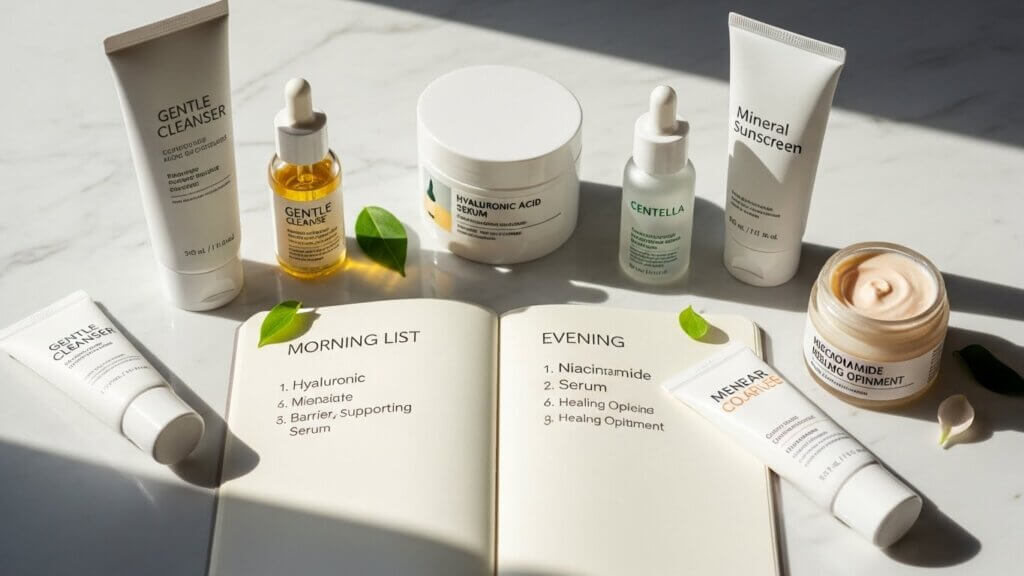
Everyone’s skin is unique, but here’s a starter routine that works for many with sensitive skin:
Morning:
– Gentle cleanser (or just rinse with water)
– Hydrating serum with hyaluronic acid (optional)
– Moisturizer with barrier-supporting ingredients
– Mineral sunscreen
Evening:
– Gentle cleanser
– Soothing treatment (like a centella product or niacinamide serum)
– Richer moisturizer or healing ointment
For extremely reactive periods, you might benefit from a [skin cycling routine](/skin-cycling-sensitive-skin) that alternates active ingredients with recovery nights.
When to Seek Professional Help
While many sensitive skin issues can be managed with the right products, some situations warrant professional attention:
– Persistent redness or irritation that doesn’t improve with gentle products
– Painful burning or stinging sensations
– Symptoms that affect your quality of life
– Sudden onset of sensitivity when you’ve never had issues before
A dermatologist can help determine if you have an underlying condition like rosacea, eczema, or contact dermatitis that requires specific treatment.
Dr. Shereene Idriss, a board-certified dermatologist, emphasizes that what appears as sensitive skin can sometimes be a treatable skin condition that needs medical intervention.
Beyond Products: Lifestyle Factors for Sensitive Skin
Your skincare routinefor is just one piece of the puzzle. Other factors that can help manage sensitive skin include:
– Using lukewarm (never hot) water for cleansing
– Patting (not rubbing) skin dry with soft towels
– Limiting exposure to extreme temperatures when possible
– Using a humidifier in dry environments
– Washing new clothes before wearing to remove manufacturing chemicals
– Choosing fragrance-free laundry detergent for pillowcases and towels
The Bottom Line on Sensitive Skin Care
Living with sensitive skin doesn’t mean you’re doomed to a lifetime of reactions and discomfort. With patience, careful product selection, and a focus on strengthening your skin barrier, you can build a routine that keeps your skin calm and healthy.
Remember that the best hypoallergenic skincare routine is one that works specifically for your skin. What triggers reactions in one person may be perfectly tolerable for another, so listen to your skin and adjust accordingly.
By prioritizing gentle, minimalist formulations and introducing products slowly, you’ll discover the perfect combination of gentle moisturizers for sensitive skin naturally and complementary products that keep your complexion comfortable.
Have you found products that work wonders for your sensitive skin? Or do you have questions about managing reactivity? Let us know in the comments below!